Why Is My Emergency Light Flashing? A Guide for Facilities Managers

TL;DR
A flashing indicator is usually the fitting telling you its status, not a fault in itself. Self-test fittings flash while a test runs and some flash while the battery recharges.
A red or amber indicator, a fast flash, or a pattern that does not clear after a day normally means a fault: battery, lamp, charger or supply.
The meaning of each colour and pattern varies by manufacturer, so check the legend on the fitting or its instructions before acting.
If the light itself flickers or flashes during normal power, treat it as a fault and have it checked.
Every fault and repair should be written in the emergency lighting log so you can show it was closed out.
It is a common sight on a walk round: one emergency light near a fire exit is flashing when the rest of the corridor shows a steady green. Sometimes it clears by itself the next day. Sometimes it is still flashing at the next monthly check. Knowing which is which saves a call-out when nothing is wrong, and stops a real fault sitting unnoticed on an escape route.
Why is my emergency light flashing?
Most emergency lights have a small indicator, usually an LED, that shows whether the fitting is charging and healthy. On self-test fittings the same indicator also reports test results. A flash normally means one of three things: a test is in progress, the battery is recharging after a test or power cut, or the fitting has found a fault. Steady green is normally the healthy state. Red, amber or a pattern that does not settle points to a fault that needs attention.
What do the different flashing patterns mean?
There is no single code used by every manufacturer, so always check the label inside the diffuser or the product instructions. On many self-test fittings the patterns follow a similar logic:
Steady green: mains present, battery charging or charged, no fault found.
Flashing green: a functional or duration test is running, or the battery is recharging after one.
Flashing or steady red or amber: a fault found at the last test, commonly the battery, the lamp or LED module, or the charging circuit.
No indicator at all: no mains supply to the fitting, a failed charger or a failed indicator. The fitting may not be charging.
If a fitting is on a central battery system, the indicators on the panel tell you more than the individual fittings. Our article on what a central battery fault light means covers that set-up.
Is a flashing emergency light normal after a power cut or test?
Often, yes. After a power cut, a flick test or a duration test, the battery has to recharge, and some fittings flash until it is full. Emergency luminaires are generally designed to recharge within 24 hours. If the indicator returns to steady green within a day, the fitting is usually fine. If it is still flashing or showing red after that, the battery is likely not taking a charge and the fitting has a fault.
What faults make an emergency light flash red or amber?
These are the everyday causes found on site:
A worn-out battery. Batteries lose capacity with age and heat, and a tired battery will often fail a duration test or not hold its charge. See our article on emergency lights cutting out early in the duration test.
A failed lamp or LED module, so the fitting cannot light in emergency mode.
A charging circuit fault, often after a surge or water ingress.
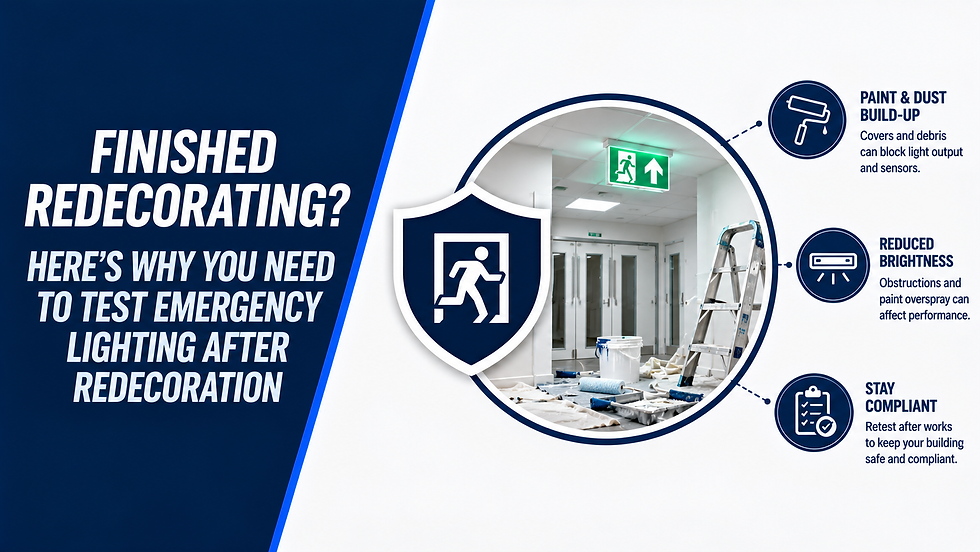
A loose or disturbed supply, for example after redecoration or ceiling works. Our redecoration check explains what to test before signing contractors off.
The unswitched supply turned off, so the fitting thinks the mains has failed and runs its battery down.
What if the light itself flickers or flashes?
That is different from the indicator. If the main lamp flickers or flashes on and off while the building has normal power, the fitting may be dropping in and out of emergency mode because of a loose connection or a failing driver, or the battery may be cycling. It is a fault either way. A related problem, a light that stays lit when it should be off, is covered in our article on why an emergency light won't turn off.
Can you ignore a flashing emergency light?
No. Under the Regulatory Reform (Fire Safety) Order 2005, the responsible person must keep emergency lighting maintained in working order, and BS 5266-1 sets out the routine of monthly functional tests and an annual full duration test. A fitting showing a fault may not light the escape route when the power goes. It also leaves a gap in your log that an auditor or fire risk assessor will pick up.
What should you do when you spot one?
Note the location and the pattern (colour, steady or flashing, fast or slow).
Check for an obvious cause: a recent power cut or test, works in the area, or the local test key switch left off.
Give it 24 hours if it was recently tested or had a power cut, then check again.
Log it as a fault if it has not cleared, and arrange a repair rather than waiting for the next scheduled test.
Record the fix and retest the fitting so the log shows a pass.
Regular emergency light testing by a competent person catches these faults on a schedule, rather than relying on someone noticing a flashing light in passing.
What to do next: how Protest ES Ltd helps
Protest ES Ltd works with facilities managers, managing agents and FM providers across commercial, education, healthcare and public sector estates. We don't simply identify compliance issues. We help clients close them:
Emergency light testing: monthly functional and annual duration tests to BS 5266-1, with fitting-by-fitting results and a clear fault list
Electrical remedials to replace failed batteries, lamps, LED modules and fittings, then retest and record the pass
Fixed wire testing and EICRs on the circuits that feed your emergency lighting
NICEIC accredited electrical work, with records ready for your fire risk assessor and auditors
One visit, more disciplines. Most FMs use separate contractors for fire doors, fire stopping and electrical testing, each with its own access, programme and paperwork. Protest ES Ltd delivers electrical compliance, passive fire protection, including fire stopping and fire compartmentation, and fire door work on the same visit: one contractor, one programme, one set of records across every site.
If you have emergency lights showing faults that keep coming back, get in touch with our team or visit Protest ES Ltd.
Further reading from Protest ES Ltd
Frequently asked questions
What does a green flashing light on an emergency light mean?
On many self-test fittings it means a test is running or the battery is recharging after one. It should return to steady green within about a day. If it keeps flashing, check the manufacturer's legend and treat it as a possible charging fault.
What does a red light on an emergency light mean?
A red or amber indicator normally means the fitting has found a fault, most often with the battery, the lamp or the charger. Note the pattern, check the legend on the fitting and arrange a repair.
How long does an emergency light take to recharge?
Emergency luminaires are generally designed to recharge within 24 hours after a full discharge. Until then the fitting may not last its full rated duration, which is why duration tests are best done when the building can cope with reduced cover for a day.
Can I replace an emergency light battery myself?
Battery replacement is electrical work on a life safety system, so it should be done by a competent person using the battery type the manufacturer specifies. The fitting then needs testing and the work recording in the log.
How often should emergency lights be tested?
BS 5266-1 sets a monthly functional test (a short flick test) and an annual full duration test, with results recorded in a log. Self-test fittings run these automatically but still need the results checked and recorded.
Who is responsible for emergency lighting faults?
The responsible person for the building under the Regulatory Reform (Fire Safety) Order 2005, which in practice often falls to the facilities manager. They must make sure faults are found, fixed and recorded.
Why does my emergency light keep failing after a new battery?
If a new battery fails again quickly, the cause is usually the charging circuit, heat around the fitting, or a supply that is being switched off. A fitting that keeps failing may need replacing rather than another battery.