
Finished Redecorating? Here's Why You Need to Test Emergency Lighting After Redecoration
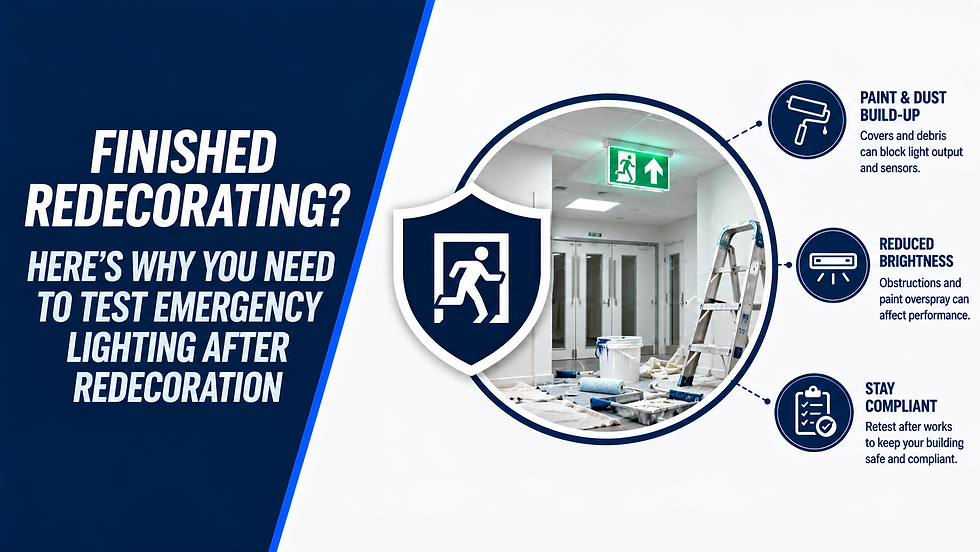
TL;DR: Do You Need to Test Emergency Lighting After Redecoration?
Paint, dust sheets or masking tape covering an emergency light's sensor, diffuser or test switch can silently disable it, even if the fitting still lights up during a quick glance.
You should test emergency lighting after redecoration before contractors leave the site, not wait for the next scheduled service.
The check takes minutes: a function test on every fitting decorators worked near, followed by a visual check for paint, tape or sealant on lenses and sensors.
Under BS 5266, the Responsible Person carries the legal duty for this check, even though the contractor caused the problem.
Skipping the check risks an emergency lighting system that looks fine on paper but fails when the power actually goes out.
Yes, you need to test emergency lighting after redecoration, and you should do it before the contractors pack up their kit. Painters and decorators routinely work within centimetres of emergency light fittings, and it takes very little paint, dust sheet residue or masking tape to disable a sensor, block a diffuser or jam a test switch. The fitting can look completely normal from the floor while quietly failing the one job it exists to do.
This is a genuine, recurring cause of emergency lighting failure across commercial buildings, and one that rarely gets flagged until the next scheduled duration test, or worse, a real power cut. For facilities managers signing off redecoration works, a short post-works check closes this gap before it becomes a compliance problem.
Why Redecoration Puts Emergency Lighting at Risk
Emergency light fittings are designed to be left alone. Decorators, by contrast, need to work around them: masking off the diffuser, moving dust sheets past the sensor, or reaching past the unit with a paint roller. None of this is done with any malice, but it creates several ways for a fitting to be compromised without anyone noticing at the time.
What Happens When Paint Covers a Sensor or Diffuser
A light film of paint or overspray on a photocell sensor can stop the fitting from detecting a loss of mains power correctly. Paint or masking tape residue on the diffuser lens reduces the light output during an emergency, even if the fitting itself still switches on. And a test switch or key-test point covered in paint or filler can make it impossible to run the routine function test at all, which hides the fault indefinitely.
How to Test Emergency Lighting After Redecoration
The check itself is quick and does not need specialist equipment. Before signing off any redecoration work near emergency lighting, run through this sequence for every fitting the contractors worked near:
Visually inspect each fitting for paint, filler, tape or dust sheet residue on the lens, sensor and test switch.
Run the fitting's short function test, usually a key switch or test button, and confirm it illuminates correctly.
Check that the indicator light, where fitted, is showing its normal status and is not obscured or covered.
Wipe down any residue you find and retest before considering the fitting clear.
Log the check against the fitting reference so it feeds into your next scheduled test cycle.
If any fitting fails this quick check, treat it the same way you would treat any other emergency lighting fault: log it, restrict use of the area if necessary, and get it inspected properly rather than assuming a wipe with a cloth has fixed it.
Who Is Responsible for the Check, You or the Contractor?
Under BS 5266, the Responsible Person for the building carries the legal duty to keep emergency lighting in working order, regardless of who caused the fault. A decorating contractor has a duty of care not to damage building systems while they work, but that does not transfer the compliance obligation away from you.
In practice, the most workable approach is to make the post-redecoration check part of the contractor's sign-off, alongside the standard snagging list. Building it into the handover means any paint-related faults get caught and corrected while the contractor is still on site and accountable, rather than surfacing weeks later at the next scheduled test.
What Happens If You Skip the Post-Redecoration Test?
Skipping the check does not make the risk disappear, it just delays when you find out about it. A fitting disabled by paint will usually pass a casual glance, because the light still appears to work under normal mains power. The fault only becomes obvious during an actual duration test, or during a real power outage, which is precisely the moment you need every fitting working.
There's also a documentation gap to consider. If your emergency lighting log shows a clean test result from before the redecoration work, and no record of a check afterwards, you have no evidence the system was still compliant in between. That gap is exactly the kind of thing an assessor or insurer will ask about after an incident.
How Often Should Emergency Lighting Be Tested Anyway?
Outside of redecoration works, routine emergency lighting testing still follows its normal schedule: a brief monthly function test and an annual full duration test, in line with BS 5266. A post-redecoration check does not replace this cycle, it simply catches damage that happens between scheduled tests, at the point it is most likely to occur and easiest to fix.
For facilities management teams juggling multiple contractor visits across a portfolio, building this check into every redecoration project's snagging process is a small addition that closes a real, recurring gap. If a check does uncover a fault, such as a fitting that won't turn off or a duration test failure, it should be logged and investigated in the same way as a central battery fault light would be. If you would rather have this handled for you, you can book an emergency lighting check with our team.

Frequently Asked Questions
Do decorators need to avoid emergency light fittings completely?
No, but they should mask carefully rather than spray paint directly onto the fitting. Ask contractors to remove or properly mask diffusers, sensors and test switches rather than painting around them freehand, and to flag it if they think overspray has reached a fitting.
Can a coat of paint really stop an emergency light from working?
Yes. A thin film of paint over a photocell sensor can prevent it from detecting a loss of mains power, and paint or tape residue on a test switch can make the fitting impossible to test, which hides a fault rather than fixing it.
How soon after redecoration should I test emergency lighting?
Ideally before the contractor leaves site, as part of the sign-off and snagging process. If that is not possible, test within a few days, and always before the next scheduled monthly check.
Who is legally responsible if a painted-over emergency light fails?
The Responsible Person for the building holds the legal duty under BS 5266, even if a contractor caused the fault. That is why building the check into contractor sign-off matters, it protects you as much as it protects the building.
What's the quickest way to check a fitting after decorating?
Run the fitting's short function test using its key switch or test button, and check the lens and sensor visually for paint, tape or filler residue. Most fittings can be checked in under a minute.
Does this apply to fittings that already passed their last annual test?
Yes. A fitting that passed its last annual duration test can still be disabled afterwards by redecoration work. The annual test only confirms the fitting worked on the day it was tested, not that it will still work after contractors have been in.
Should I log a post-redecoration check the same way as a routine test?
Yes. Record which fittings were checked, the date, and the outcome, and keep it alongside your routine emergency lighting log. This keeps your compliance evidence intact even for ad hoc checks outside the normal schedule.


.png)