
RCD Testing for Commercial Buildings: What Facilities Managers Need to Know
TL;DR
RCD testing protects people and equipment from electric shock and fire caused by earth faults.
Testing sits within your wider EICR and BS 7671 periodic inspection cycle, not as a standalone task.
Frequency depends on RCD type, building use, and your risk assessment, rather than one fixed rule for every site.
A failed RCD test should trigger prompt remedial action, not a wait and see approach.
Combining RCD testing with your fixed wire testing and passive fire protection programme reduces disruption across multi-site portfolios.
Residual current devices, or RCDs, are one of the most important safety components in any commercial electrical system. They cut the power automatically when they detect an imbalance in current, the kind of fault that can cause electric shock or start a fire. For facilities managers responsible for multi-site portfolios, keeping RCDs tested and compliant is not optional. It is a core part of meeting your duties under the IET Wiring Regulations (BS 7671) and the Electricity at Work Regulations 1989. This guide explains what RCD testing involves, how often it should happen, and what to do when a test uncovers a problem.
What Is RCD Testing and Why Does It Matter?
An RCD constantly monitors the current flowing through a circuit. If it detects current leaking to earth, through a damaged cable or faulty appliance, it cuts the power in a fraction of a second. This function protects people from electric shock and reduces the risk of electrical fires starting unnoticed behind walls or ceilings.
RCD testing checks two things. First, it confirms the device trips within the required time when a fault is simulated. Second, it confirms the device does not trip unnecessarily during normal use, which is known as nuisance tripping. Both checks matter. A device that fails to trip when needed puts people at risk. A device that trips too often disrupts operations and can push staff to bypass safety features altogether.
How Often Should RCDs Be Tested in Commercial Buildings?
There is no single fixed frequency that applies to every building. Instead, testing frequency should reflect the type of RCD, how the building is used, and the findings of your fire risk assessment and electrical risk assessment. As a general principle, the higher the risk to people or the more intensive the use of the electrical installation, the more frequently RCDs should be checked.
Testing Frequency by Building Type
Offices and low-risk commercial premises typically align RCD checks with the wider periodic inspection cycle. Retail units, industrial sites, and buildings with high footfall or specialist equipment often warrant more frequent functional checks between full inspections. Healthcare and education settings usually sit at the higher end of testing frequency because of the vulnerability of building occupants. Your competent contractor should confirm the right schedule for your specific sites rather than applying a generic rule.
How RCD Testing Fits Into Your EICR Cycle
RCD testing is not a separate task bolted onto your compliance programme. It is one of the checks carried out as part of a full Electrical Installation Condition Report (EICR). During a periodic inspection, a qualified engineer tests every RCD in the installation alongside the wider fixed wire testing programme, then records the results on the certificate. Keeping RCD testing aligned with your EICR cycle avoids duplicate site visits and gives you one clear compliance record rather than several scattered ones.
What Happens During an RCD Test?
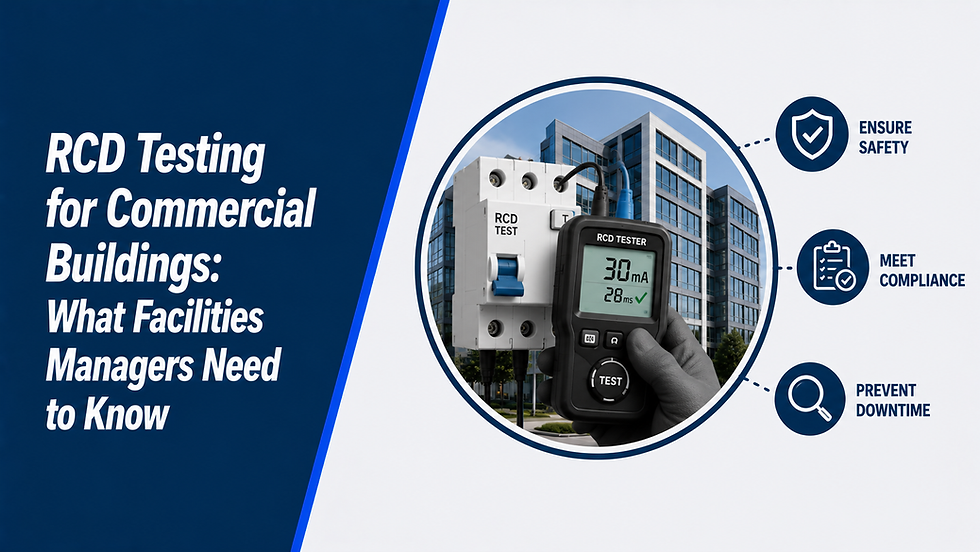
A competent electrician carries out RCD testing using a calibrated test instrument. The engineer applies a simulated fault current and measures how long the device takes to disconnect the supply. This is checked against the trip times set out in the relevant British Standard for the device type. The engineer also carries out a ramp test on some devices to confirm the trip current itself, not just the trip time.
Alongside the instrument test, the engineer checks the built in test button on each RCD. This button simulates a fault manually and should be tested by site staff on a regular basis between full inspections, in line with manufacturer guidance. A test button that does nothing when pressed is an early warning sign that should never be ignored.
Common RCD Faults and What They Mean
A few issues come up repeatedly during RCD testing.
Nuisance tripping often points to circuits that are overloaded or that share too many appliances on a single RCD. It can also indicate moisture ingress or an ageing device nearing the end of its service life.
Failure to trip within the required time is more serious. It usually means the device itself has failed or has been wired incorrectly, and it should be treated as an urgent remedial item rather than something to monitor. Findings like this typically appear on an EICR as a coded observation, and the code assigned tells you how quickly it needs to be addressed.
Corrosion or physical damage to the RCD enclosure is also common in older installations, particularly in plant rooms or external locations exposed to damp conditions. If your building has previously received an unsatisfactory EICR result, it is worth checking whether RCD faults contributed to that outcome.
Who Is Responsible for RCD Testing Compliance?
Under the Electricity at Work Regulations 1989, the duty holder, usually the employer, building owner, or landlord, must ensure electrical systems are maintained to prevent danger. In practice, this responsibility is usually delegated to the facilities manager, who commissions testing, tracks certificates, and arranges remedial work when a test uncovers a fault.
Getting the testing frequency right for each site, and keeping clear records of every test and its outcome, is central to demonstrating compliance if your organisation is ever asked to evidence its electrical safety management.
Choosing a Contractor for RCD Testing
RCD testing should only be carried out by a competent electrician working to a recognised scheme, such as NICEIC or NAPIT. For facilities managers overseeing multiple sites, there is a clear operational advantage in using a single contractor who delivers RCD testing, wider EICR work, and passive fire protection inspections together. This reduces the number of separate site visits, cuts down on scheduling conflicts, and gives you one point of contact for your entire compliance programme rather than several disconnected suppliers.
Frequently Asked Questions
What is an RCD and how does it work?
An RCD, or residual current device, is a safety switch that monitors current flowing through a circuit. If it detects current leaking to earth, it disconnects the power automatically within a fraction of a second, protecting people from electric shock and reducing fire risk.
How often should RCDs be tested in a commercial building?
There is no single rule for every building. Testing frequency depends on the RCD type, how intensively the building is used, and the outcome of your risk assessment. A competent contractor will recommend a schedule based on your specific sites, usually aligned with your periodic EICR cycle.
Is RCD testing part of an EICR?
Yes. RCD testing is one of the checks carried out during a full Electrical Installation Condition Report. A qualified engineer tests every RCD in the installation alongside the wider fixed wire testing and records the results on the certificate.
What happens if an RCD fails its test?
A failed RCD test should be treated as an urgent finding rather than something to monitor over time. Depending on the nature of the fault, it will usually be recorded as a coded observation on your EICR and should be remedied promptly by a qualified electrician.
Can building staff test RCDs themselves?
Site staff can and should carry out the simple push button functional test between full inspections, following manufacturer guidance. However, the full instrument based testing that measures trip times must be carried out by a qualified and competent electrician.
What standards govern RCD testing in the UK?
RCD testing in the UK is governed by the IET Wiring Regulations, BS 7671, alongside the Electricity at Work Regulations 1989, which places a legal duty on employers and building owners to maintain electrical systems safely.
Why should RCD testing be combined with wider electrical compliance?
Combining RCD testing with your EICR and passive fire protection programme reduces the number of separate contractor visits, simplifies scheduling across multiple sites, and gives facilities managers one clear compliance record instead of several disconnected ones.


.png)