
Fire Assembly Point Sign Faded or Missing? Here's What the Assembly Point Sign Requirements Actually Say

TL;DR
Yes, a faded or missing fire assembly point sign is a genuine fire risk assessment finding, not just a facilities snagging item.
The assembly point sign requirements under BS 5499-4 cover colour, symbol, photoluminescent class, size and position, and a sign that fails on any of these no longer meets the standard.
Photoluminescent signs need to be "charged" by ambient light to glow in a power cut, so a sign in a dim stairwell or plant area may fail even if it looks fine in daylight.
If your sign has failed, log it as an action on your fire risk assessment, replace it with a sign that meets BS 5499-4, and confirm the new position is visible along the actual escape route.
Who arranges and pays for the replacement depends on your lease and building setup. Read the responsibility breakdown here.
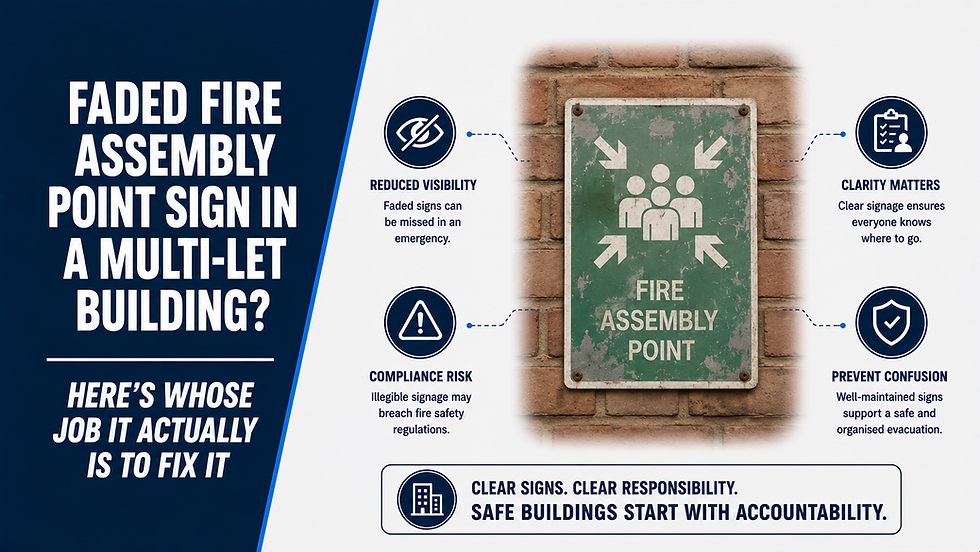
A faded or missing fire assembly point sign is a genuine finding on your fire risk assessment, not a facilities snagging item you can leave for the next redecoration cycle. The assembly point sign requirements set out in BS 5499-4 exist precisely because staff and visitors need to find the muster point without hesitation, in daylight, in the dark, or in a smoke-filled corridor. If you have just noticed your sign has bleached out, cracked, or vanished entirely, this guide explains exactly what the requirements say, how to check whether your current sign still meets them, and what to do next.
Is a Faded or Missing Assembly Point Sign a Fire Risk Assessment Finding?
Yes. Under the Regulatory Reform (Fire Safety) Order 2005, the responsible person must ensure escape routes and assembly arrangements are clearly signed and maintained, and a sign that has faded past legibility or disappeared entirely no longer fulfils that duty. Fire risk assessors are trained to check assembly point signage as a matter of course, alongside fire exit signs and extinguisher positioning, because an evacuation plan that nobody can follow in practice is not a functioning evacuation plan.
This matters most in a real evacuation, when people are moving quickly, possibly through smoke or in poor light, and relying on signage rather than memory. A sign that has become unreadable removes exactly the cue staff are trained to look for during a fire drill or an actual incident.
What Do the Assembly Point Sign Requirements Under BS 5499-4 Actually Say?
The assembly point sign requirements under BS 5499-4, the British Standard code of practice for escape route signing, cover four things: colour and symbol, photoluminescent performance, size and legibility, and position. A sign that fails on any one of these no longer meets the standard, even if it is still physically present on the wall.
Colour, Symbol and Legibility
A compliant assembly point sign uses the standard green and white "safe condition" format, with a pictogram showing people moving towards a defined point. The text and symbol need to remain legible from a reasonable viewing distance. Fading, cracking, peeling or heavy staining that obscures the pictogram or wording is enough to fail this requirement, even if the sign is technically still readable up close.
Photoluminescent Class and Visibility in Low Light
BS 5499-4 classifies photoluminescent sign materials into performance classes, and signs relying on this glow-in-the-dark charge need enough ambient light during normal hours to "charge" properly. A sign fitted in a dim stairwell, a plant room, or an area with weak lighting can fail this requirement even though it looks perfectly fine to the naked eye in daylight. If your building relies on photoluminescent signage rather than illuminated signs, this is worth checking specifically, not just assumed to be fine because the sign "looks new."
Position and Sightlines
The sign needs to be positioned where it will actually be seen along the genuine escape route, not just somewhere convenient. If furniture, planting, parked vehicles, or a new partition wall now blocks the sightline to the sign, it has effectively failed the requirement even if the sign itself is in perfect condition.
How Do You Know If Your Current Sign No Longer Meets the Requirements?
Walk the actual escape route your staff would use, not the route you assume they would use, and check the sign from a normal walking pace rather than standing directly in front of it. Ask whether the symbol and wording are legible from a reasonable distance, whether the colour has faded to the point of being ambiguous, and whether anything now blocks the sightline that did not block it when the sign was first installed.
If the sign is photoluminescent, check it during the hours it would need to work, typically after dusk or during a simulated power cut, rather than assuming daylight visibility is enough. A sign that looks bright and legible under office lighting can still fail to glow adequately if it has not received enough ambient charge throughout the day.
What Should You Do If Your Assembly Point Sign Has Failed These Checks?
First, log the finding on your fire risk assessment as an identified action with a target date, rather than fixing it quietly and leaving no paper trail. Assessors and enforcing authorities want to see that issues are tracked, not just resolved. Second, replace the sign with one that meets the assembly point sign requirements in full, matching the correct photoluminescent class for its location or specifying an illuminated sign if ambient light is genuinely insufficient. Third, confirm the new sign's position against the actual escape route, ideally by walking it with someone unfamiliar with the building, since familiarity can hide sightline problems that a fresh pair of eyes will spot immediately.
Finally, build a visual check of assembly point signage into your routine fire drill process, so a faded or blocked sign gets caught at the next drill rather than sitting unnoticed for another assessment cycle. Reviewing signage alongside your wider fire risk assessment review frequency keeps this from becoming a recurring gap.
Who Should Replace the Sign and Confirm It Meets the Requirements?
Who arranges and pays for a replacement sign depends on who controls the land or building element it sits on, which gets more complicated in shared or multi-let sites than in a single-occupier building. We have covered this specific question, including how responsibility typically splits between landlords, tenants and FM contractors, in a separate guide on assembly point sign responsibility. Whoever ends up responsible, the replacement itself should be checked against BS 5499-4 rather than simply matched to whatever was there before, since the original sign may already have been non-compliant before it faded.
If you are unsure whether your current signage would pass scrutiny, a commercial fire risk assessment will flag it alongside every other finding across the building, giving you one prioritised action list rather than a series of one-off fixes. This is also a good moment to check your wider signage against the legal fire risk assessment requirements for UK businesses, since assembly point signs are rarely the only gap found during a proper review.
Frequently Asked Questions
Is a faded fire assembly point sign actually a compliance issue, or just cosmetic?
It is a genuine compliance issue, not a cosmetic one. Under the Regulatory Reform (Fire Safety) Order 2005, the responsible person must maintain clear signage for escape routes and assembly points, and a sign that has faded past legibility no longer meets that duty. Fire risk assessors will record it as a finding requiring action, with a target date for replacement.
What colour and symbol should a compliant assembly point sign use?
A compliant sign uses the standard green and white "safe condition" format with a pictogram showing people moving towards a defined assembly point. The wording and symbol need to stay legible from a reasonable viewing distance. If fading, cracking or staining has obscured either element, the sign no longer meets BS 5499-4.
Does an assembly point sign need to be photoluminescent?
Not necessarily, but it does need to remain visible in low light or a power cut, and photoluminescent material is the most common way to achieve that. BS 5499-4 sets performance classes for photoluminescent signage, and a sign in a poorly lit area may need a higher class or an illuminated alternative. If your sign relies on photoluminescence, check it is receiving enough ambient light to charge properly during normal hours.
How high should an assembly point sign be positioned?
There is no single fixed height in the standard, but the sign needs to sit where it will actually be seen along the genuine escape route, typically at a normal eye-level viewing point rather than somewhere merely convenient to fix it. If new furniture, planting or a parked vehicle now blocks the sightline, the position has effectively failed even if the sign itself is undamaged.
How often should assembly point signage be checked?
Assembly point signage should be checked at every fire risk assessment review and ideally spot-checked during routine fire drills, since fading and blocked sightlines can develop between formal reviews. Building a quick visual check into your drill process catches problems months before the next scheduled assessment would otherwise flag them.
Who pays to replace a faded assembly point sign in a rented building?
It depends on who controls the land or building element the sign sits on, which usually comes down to the lease terms between landlord and tenant, or the FM contract if a managing agent is involved. We cover this responsibility split in detail in our guide on fire assembly point sign responsibility.
Can a faded sign really invalidate a fire risk assessment?
A single faded sign will not invalidate an entire fire risk assessment on its own, but it will appear as an open finding that needs resolving, and an assessment with unresolved findings left unaddressed for a long period can expose the responsible person to enforcement action. The safer approach is to log it, fix it within a reasonable timeframe, and keep the record showing it was actioned.


.png)