
Faded Fire Assembly Point Sign in a Multi-Let Building? Here's Whose Job It Actually Is to Fix It
TL;DR
In a single-occupier building, replacing a faded or missing fire assembly point sign is the responsible person's job, usually the employer or building owner.
In a multi-let building, responsibility for a fire assembly point sign normally sits with the landlord or managing agent for shared external areas, unless the lease says otherwise.
A faded or illegible sign is a live finding under the Regulatory Reform (Fire Safety) Order 2005, not a cosmetic issue, and should be logged and actioned from the next fire risk assessment.
If nobody has clearly been given the job, it defaults to whoever holds the responsible person duty for that part of the building, and that needs establishing before the next review.
Once responsibility is confirmed, replacing the sign is a same-week fix for most FM contractors.
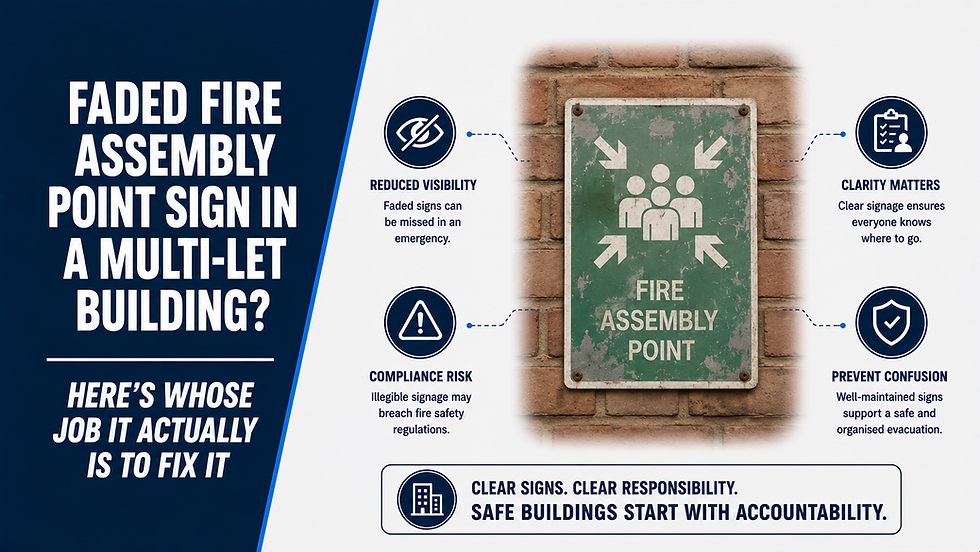
Noticed the fire assembly point sign outside your building has faded to the point of being unreadable, or has disappeared altogether? In a multi-let building, the real question is rarely whether it needs replacing. It is whose job that actually is. The answer usually sits in the lease and the building's fire risk assessment, not in guesswork between neighbouring occupiers.
Who Is Responsible for a Faded Fire Assembly Point Sign?
Responsibility for a fire assembly point sign follows whoever controls the land the sign sits on. In a single-occupier building, that is straightforward: the responsible person named in the fire risk assessment, typically the employer, owner or manager, is accountable for keeping signage legible and in place. In a multi-let building, the sign almost always sits on shared land such as a car park, forecourt or communal garden, which puts the duty on the landlord or managing agent rather than any individual tenant, unless the lease specifically hands fire safety obligations to occupiers.
This matters because a fire risk assessment names a single responsible person for each part of a building, and enforcement action under the Regulatory Reform (Fire Safety) Order 2005 follows that name. If your assembly point sign has faded and nobody has claimed ownership of fixing it, that gap itself becomes something a fire risk assessor will want resolved.
Single-Occupier vs Multi-Let Buildings: Why Responsibility Changes
The distinction between single-occupier and multi-let buildings is the single biggest factor in who pays to replace a faded fire assembly point sign, and it catches a lot of facilities teams out.
What the Lease Usually Says
Most commercial leases include a clause covering common parts and shared fire safety equipment. Assembly point signage, being external and shared, is usually classed as a common part item, which means it falls to the landlord or the managing agent acting on the landlord's behalf. Some leases push specific compliance costs back to tenants through the service charge, so the landlord may still pay for the physical replacement while recovering the cost from occupiers collectively. Always check the service charge schedule alongside the fire safety clause, since the two are often read together.
When the Landlord Is Responsible
Where the assembly point sits on land retained by the landlord, such as a shared car park or forecourt, the landlord is usually the responsible person for that specific asset, even if each tenant has their own responsible person inside their unit. This is a common source of confusion during a fire risk assessment, because a tenant's internal assessment may correctly flag the sign as a finding without the tenant having any power to fix it themselves.
When the Tenant or Occupier Is Responsible
If a single tenant occupies the whole site, including the land the assembly point sits on, or the lease explicitly transfers fire safety responsibility for external areas to the tenant, then replacing the sign is down to that occupier. It is worth confirming this in writing rather than assuming, particularly after a change of tenancy, since incoming occupiers do not always inherit clarity about who last owned this task.
Is a Faded Fire Assembly Point Sign a Fire Risk Assessment Finding?
Yes. A faded, illegible or missing fire assembly point sign is a genuine finding, not a facilities snagging item to deal with whenever convenient. Fire risk assessments assess whether staff and visitors can be accounted for safely following an evacuation, and a sign nobody can read at a distance, or that has vanished entirely, directly undermines that. Assessors will typically record it, assign it a priority based on how likely it is to cause confusion during a real evacuation, and expect to see it closed out by the next review, similar to how an outdated fire marshal list is treated as a live compliance gap rather than paperwork.
The severity often depends on context. A single faded sign at a site with clear sightlines and a small headcount is a lower-priority finding than a missing sign at a large, multi-tenant site with a complex evacuation route or a history of blocked fire exits.
What Happens If Nobody Has Been Assigned the Job?
If a faded fire assembly point sign sits unresolved because ownership is unclear, the responsible person for the building as a whole is expected to step in and either fix it directly or formally assign the task, rather than leaving it open indefinitely. Fire risk assessors do not accept "it's not my sign" as a closing statement on a finding. In practice, this usually means the managing agent contacts the landlord in writing, sets a deadline, and documents the instruction so there is a clear record if the point is ever queried by a fire and rescue authority or an insurer.
Leaving responsibility unresolved carries the same risk as leaving equipment unfixed, similar to an empty fire extinguisher bracket that nobody has reported. It is rarely deliberate neglect. It is usually a gap that opens up between separate parties who each assumed someone else was covering it.
What Compliant Fire Assembly Point Signage Should Look Like
Replacement signage should follow BS 5499-4 and use the pictograms and colours set out in BS EN ISO 7010, so it is instantly recognisable regardless of language. As a minimum, a compliant fire assembly point sign should be:
Made from a rigid, weather-resistant material suitable for permanent outdoor mounting
Fitted with the standard green and white running man pictogram and clear "Fire Assembly Point" or "Assembly Point" wording
Positioned at a height and distance that keeps it legible from the direction people will be evacuating
Free from fading, cracking or obstruction by planting, vehicles or other signage
Reviewed as part of the same schedule as other external fire safety checks, not left to be noticed by chance
What Should You Do Next?
Start by checking the lease or management agreement to confirm who holds responsibility for the land the sign sits on. If that is unclear, raise it formally with the landlord or managing agent rather than letting it sit as an informal conversation. Whoever is accountable can then instruct a contractor to survey the site and replace the sign to the correct standard. If you would rather have a qualified team confirm what is needed and carry out the work, you can get a quote or get in touch to arrange a site visit.
Who is responsible for maintaining fire assembly point signs?
Whoever controls the land the sign is fixed to is responsible. In a single-occupier building that is usually the employer or owner. In a multi-let building it is typically the landlord or managing agent, unless the lease assigns that duty to a tenant.
Is a faded fire assembly point sign a fire risk assessment failure?
It is treated as a genuine finding rather than a failure in itself, though a fire risk assessor will expect it to be logged, prioritised and closed out by the next review. Leaving it unresolved across multiple assessments can escalate its priority.
Can a tenant be held liable for a missing assembly point sign?
Only if the lease specifically transfers responsibility for that external area or fire safety equipment to the tenant. Where the sign sits on land retained by the landlord, liability usually stays with the landlord even if the tenant first spots the problem.
How quickly should a faded fire assembly point sign be replaced?
There is no fixed statutory deadline, but it should be actioned within a timeframe proportionate to the risk, and most responsible persons treat it as a same-month fix once ownership is confirmed. A high-occupancy site with a complex evacuation route warrants faster action than a small, low-footfall building.
What standard should fire assembly point signage meet?
Signage should follow BS 5499-4 for fire safety signage and use the pictograms and colour coding set out in BS EN ISO 7010, so the sign is recognisable and durable enough for permanent outdoor use.
Who pays for replacing fire safety signage in a multi-let building?
This depends on the lease. The landlord often pays directly for shared external signage and may recover the cost through the service charge, so tenants can still see a cost impact even though the landlord organises the work.
Does a missing assembly point sign affect fire risk assessment scoring or grading?
It can. A missing sign at a site with a complex or high-occupancy evacuation route is likely to be weighted more heavily than the same finding at a small, simple site, because the potential consequence of confusion during an evacuation is greater.


.png)