
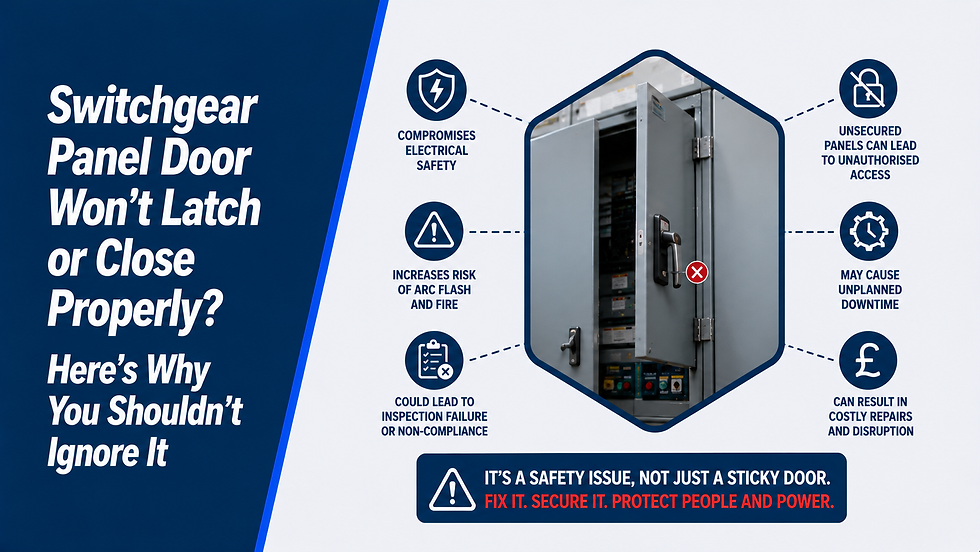
Switchgear Panel Door Won't Latch or Close Properly? Here's Why You Shouldn't Ignore It
TL;DR
A switchgear panel door that won't latch or close properly is not a cosmetic fault. It breaks the enclosure's IP rating and its arc-fault containment, meaning the panel is no longer providing the protection it was designed and certified for.
The most common causes are a distorted or misaligned door frame, a worn or broken latch mechanism, corrosion or debris in the latch housing, incorrect reassembly after maintenance, and physical impact damage.
A switchgear panel door fault should be treated as a defect requiring action, not a "note it and move on" observation. Depending on severity, it can justify an EICR code of C2 (potentially dangerous) or C1 (danger present).
Whether you repair the door and latch or escalate to full panel replacement depends on the extent of distortion, the age and condition of the switchgear, and whether the enclosure's structural integrity has been compromised.
Left unaddressed, a compromised switchgear panel door increases the risk of injury during arc fault events, invalidates the enclosure's protection rating, and can leave duty holders exposed under the Electricity at Work Regulations 1989.
Introduction
A switchgear panel door that won't latch or close properly means the enclosure can no longer contain an internal arc fault or keep out dust, moisture and unauthorised hands, regardless of how minor the fault looks from the outside. That is the direct answer. The detail of why, and what to do about it, is below.
For contractors and specifiers carrying out routine site visits, this is a familiar moment. You are walking a plant room or electrical intake cupboard, checking off a switchgear inspection, and you reach for a panel door that should swing shut with a firm, confident click. Instead it hangs slightly proud of the frame, or the latch catches but does not seat, or it closes but flexes visibly under hand pressure. It is easy to note it as a minor mechanical snag and move on to the electrical checks that feel more urgent. That instinct is understandable, but it is the wrong call. A switchgear enclosure is only as protective as its weakest point, and a door that does not seal properly is exactly that weak point.
This article sets out what a failed switchgear panel door latch or closure actually means for compliance, the most common causes contractors find on site, the standards that govern enclosure integrity in the UK, and a practical framework for deciding whether to repair the door or escalate to panel replacement. It applies equally to standard LV distribution switchgear and to purpose-built systems such as Volt Logic switchgear.
Is a Switchgear Panel Door Latch Fault a Compliance Failure?
Yes. A switchgear panel door that will not latch or close fully is a compliance failure because it defeats the enclosure's designed IP rating and its ability to contain an internal arc fault, both of which are safety-critical functions rather than cosmetic ones.
Low voltage switchgear assemblies are tested and certified as complete enclosures under BS EN 61439, and that certification covers the assembly as built, including its doors, latches and seals. The moment a door will not close and latch as designed, the assembly no longer matches the tested and certified configuration. From a compliance standpoint, this is not a grey area. An open or poorly seated door is treated the same way a missing panel or a bypassed interlock would be treated: as a breach of the enclosure's protective envelope.
This matters practically because it changes how the finding should be recorded and actioned. A switchgear panel door fault found during a routine visual inspection or an Electrical Installation Condition Report should not be logged as an observation to revisit "at some point." Depending on severity, most competent persons will code it as a C2 (potentially dangerous, requiring urgent remedial action) or, where there is clear evidence of prior overheating, arcing, or a severely compromised seal, a C1 (danger present, requiring immediate action).
Common Causes of a Switchgear Panel Door That Won't Latch or Close
There is rarely a single cause. In practice, contractors tend to find one of five recurring issues, sometimes in combination.
Distorted or Misaligned Door Frame
Switchgear enclosures are sheet steel structures, and sheet steel moves. Thermal cycling from load current, physical knocks during building works, or simply age and settlement of the enclosure can leave the door frame very slightly out of true. A misalignment of only a few millimetres is often enough to stop a latch engaging fully, even though the door still appears to close from a distance. This is one of the most common findings on switchgear that has been in service for ten years or more, particularly in plant rooms that see regular foot traffic or nearby vibration from HVAC plant.
Worn or Broken Latch Mechanism
Mechanical latches, whether a simple hook-and-keep arrangement or a more elaborate multi-point locking handle, wear with repeated use. Springs weaken, cam surfaces round off, and keeps deform slightly with each cycle. On older switchgear this wear can accumulate over years of routine access for switching operations, inspections and maintenance, until the latch no longer draws the door tight against its seal. In some cases the latch handle itself has sheared or the internal linkage has disconnected, which is usually obvious once the enclosure is opened up for inspection.
Corrosion and Debris Build-Up
Plant rooms and electrical intake cupboards are not always climate controlled, and switchgear located in basements, external kiosks or older buildings is particularly exposed to damp. Corrosion around hinges, latch keeps and strike plates is a frequent finding, and even light surface rust can be enough to prevent a latch seating cleanly. Dust, debris and, in some environments, insect or rodent nesting material can also build up inside latch housings and door seals, physically obstructing full closure.
Incorrect Reassembly After Maintenance
A switchgear panel door won't latch or close properly is sometimes a self-inflicted problem. If a panel has recently been opened for switching gear maintenance, cable termination work, or fault investigation, incorrect reassembly is a genuine possibility. A door rehung slightly out of alignment, a keep repositioned incorrectly, or fixings left loose can all present exactly the same symptom as long-term wear, which is why the maintenance history of the switchgear is one of the first things worth checking on site.
Physical Impact Damage
Switchgear rooms double as storage, corridor space, or thoroughfares in a surprising number of buildings, and enclosures get knocked. A trolley, pallet truck or piece of equipment striking a panel door can bend the frame or the door leaf itself, sometimes without leaving obvious external damage. This kind of impact damage is worth specifically asking about during a site visit, because building staff do not always report it, particularly if the door still appeared to close at the time.
Why the Switchgear Panel Door Matters More Than It Looks
It is worth being explicit about why a door fault on a switchgear panel is treated so seriously, because to someone unfamiliar with LV switchgear it can look like a minor mechanical snag rather than an electrical safety issue.
IP Rating and Ingress Protection
Switchgear enclosures are assigned an Ingress Protection rating, commonly IP3X or IP4X for indoor LV switchgear, which defines what size of solid object and what degree of moisture the enclosure is designed to keep out. That rating is only valid when the enclosure is fully assembled and closed as designed. A door that will not latch or seat properly creates a gap, however small, that compromises the rating. Dust ingress around live busbars and connections is a genuine cause of insulation breakdown and tracking faults over time, and moisture ingress can be considerably more dangerous, more quickly.
Arc Fault Containment
This is the more serious consideration for a switchgear panel door specifically. LV switchgear assemblies are designed, and in many cases tested, to contain the effects of an internal arc fault, directing the pressure wave, hot gases and debris in a controlled way rather than allowing them to vent uncontrolled into the surrounding space. A door that is not properly latched cannot perform this function. In the event of an internal fault, a compromised door is far more likely to be blown open or to fail entirely, exposing anyone nearby to arc flash energy that the enclosure was specifically designed to contain. This is precisely the scenario that makes a switchgear panel door fault a genuine life-safety issue rather than a maintenance inconvenience.
Access Control and Unauthorised Entry
A switchgear panel door that will not latch also fails at a more basic level: keeping unauthorised persons away from live low voltage equipment. Plant rooms are not always kept locked as tightly as they should be, and a door that swings open on its own, or that can be pushed open without a key, removes a layer of protection that was part of the original safety design intent for the installation.
What Standards Govern Switchgear Enclosure Doors in the UK?
LV switchgear assemblies in the UK are primarily governed by BS EN 61439, the standard covering low voltage switchgear and controlgear assemblies, which sets out requirements for mechanical construction, degree of protection, and verification of the assembly as a complete unit rather than a collection of separate components. BS 7671, the IET Wiring Regulations, sits alongside this and requires that electrical installations, including their enclosures, are maintained in a safe condition. Under the Electricity at Work Regulations 1989, the duty holder for a building has a legal obligation to ensure that electrical systems are maintained so as to prevent danger, and a switchgear enclosure that no longer meets its designed protection level is squarely within that obligation.
In practical terms, this means a switchgear panel door fault identified during an inspection is not simply a maintenance note. It ties directly into the legal duty to maintain the installation, and into the enclosure's original type-test certification, which is invalidated the moment the assembly is no longer in its tested and certified configuration. Keeping the assembly within its certified condition is one of the core aims of any ongoing electrical compliance programme.
What Should You Do Next? Repair vs Escalate
The right response to a switchgear panel door that will not latch or close depends on what is actually wrong, and this is where a proper inspection earns its keep rather than a guess from the corridor.
A straightforward repair is usually appropriate where the fault is isolated to the latch mechanism itself, such as a worn keep, a weakened spring, or light surface corrosion that can be cleaned back and treated. These are mechanical parts that can often be replaced or adjusted without any work on the enclosure structure itself, and in most cases this can be done as a planned, low-risk task once the switchgear has been safely isolated or the affected section made dead as part of a wider electrical remedial repairs programme.
Escalation to a fuller remedial scope, which may include reworking the door frame, replacing the door leaf, or in more serious cases replacing the switchgear cubicle entirely, is the right call where there is visible distortion to the frame or door itself, where the enclosure shows signs of prior overheating or arcing damage near the door seal, where the switchgear is towards the end of its typical service life and the door fault is one of several ageing indicators, or where the assembly can no longer achieve its original IP rating even after latch repairs.
A useful rule of thumb for contractors and specifiers on site: if the fix is limited to the latch hardware and the frame and door leaf are true and undamaged, repair is proportionate. If the frame, door leaf, or enclosure body itself is compromised, repair alone will not restore the assembly to its certified condition, and replacement or a more substantial remedial scope needs to go on the table.
How Often Should Switchgear Panel Doors Be Inspected?
Switchgear panel doors and latches should be checked as part of every routine LV switchgear inspection, which most UK operators run on an annual cycle, with more frequent checks appropriate for switchgear in harsher environments such as damp plant rooms, coastal locations, or sites with heavy footfall near the enclosures. A door and latch check takes very little additional time within a wider switchgear inspection, which is part of why it is worth building into a standard inspection checklist rather than treating it as a separate task. Waiting for an annual EICR or fixed wire test cycle to catch a door fault means the enclosure could be running in a compromised state for up to five years, which is longer than most duty holders would accept if the risk were explained to them plainly.
What Happens If You Ignore a Switchgear Panel Door Fault?
Ignoring a switchgear panel door that will not latch does not make the underlying problem go away, and in most cases it gets worse. A door that closes with visible flex or a partial latch tends to work itself looser over time as vibration and repeated handling continue to stress the compromised mechanism. The practical consequences of leaving it unaddressed include an increased risk of injury to anyone nearby in the event of an internal arc fault, since the enclosure can no longer contain the event as designed, a greater chance of dust or moisture ingress leading to insulation breakdown or a developing fault over months rather than years, exposure for the duty holder under the Electricity at Work Regulations 1989 if an incident occurs and the enclosure is found to have been non-compliant, and a higher likelihood that what would have been a straightforward latch repair becomes a full panel replacement once corrosion or distortion has progressed further. None of these outcomes are proportionate to the cost of fixing a latch or rehanging a door when the fault is first found.
Frequently Asked Questions
Is a switchgear panel door that won't close a fire risk?
Yes, indirectly. A switchgear panel door that will not close properly compromises the enclosure's ability to contain an internal arc fault, and an uncontained arc fault can ignite nearby combustible material or damage surrounding cabling. It is treated as a safety-critical defect rather than a fire risk in its own right, but the consequences of an uncontained fault can absolutely include fire.
Can I keep using switchgear with a faulty panel door?
The switchgear can usually continue to operate electrically, but the enclosure is no longer providing the protection it was designed and certified for. Most competent persons would code this as a C2, meaning it should be treated as urgent and scheduled for remedial action rather than left indefinitely, and a C1 code, meaning immediate action, applies where there is evidence of overheating, arcing, or a severely compromised seal.
Who is responsible for fixing a switchgear panel door fault?
The duty holder for the building, typically the landlord, employer, or facilities management team responsible for the electrical installation, holds the legal obligation under the Electricity at Work Regulations 1989 to have the fault remedied. In practice this work is carried out by a qualified electrical contractor or specialist LV switchgear engineer, often the same contractor responsible for the site's routine EICR or switchgear inspection programme.
How much does it cost to repair a switchgear panel door latch?
Cost varies significantly depending on whether the fault is limited to the latch hardware or extends to the door frame or enclosure body. A straightforward latch or keep replacement is a relatively low-cost, low-risk repair. Frame realignment or door leaf replacement costs more and requires the switchgear to be safely isolated for longer, and full cubicle replacement, needed where the enclosure itself is compromised, is the most significant cost. A proper site inspection is the only reliable way to know which category applies.
Does a switchgear panel door fault need to be reported on an EICR?
Yes. If a switchgear panel door fault is identified during an Electrical Installation Condition Report or fixed wire testing visit, it should be recorded with an appropriate observation code, typically C2 or C1 depending on severity, rather than omitted or noted as a minor observation. This gives the duty holder a clear, documented basis for prioritising the remedial work.
What is the difference between a switchgear panel door fault and a switchgear panel door not being locked?
A door fault means the latch or door itself is physically unable to close and seat correctly, regardless of whether anyone tries to lock it. A door simply left unlocked is an access control and procedural issue rather than a mechanical one, though both compromise the same protections, keeping the enclosure sealed against ingress and keeping unauthorised persons away from live equipment, and both should be corrected without delay.
How do I know if my switchgear panel door problem is urgent?
Treat it as urgent if the door will not latch at all, if there is visible distortion to the frame or door leaf, if you can see or smell evidence of prior overheating or arcing near the seal, or if the switchgear is in a high-footfall or damp location. Any of these factors increases the likelihood of ingress or a compromised arc-fault response, and a qualified electrical contractor should assess the panel as soon as reasonably practicable.


.png)