
Light Switch or Socket Feels Warm to the Touch? Here's Why You Shouldn't Ignore It
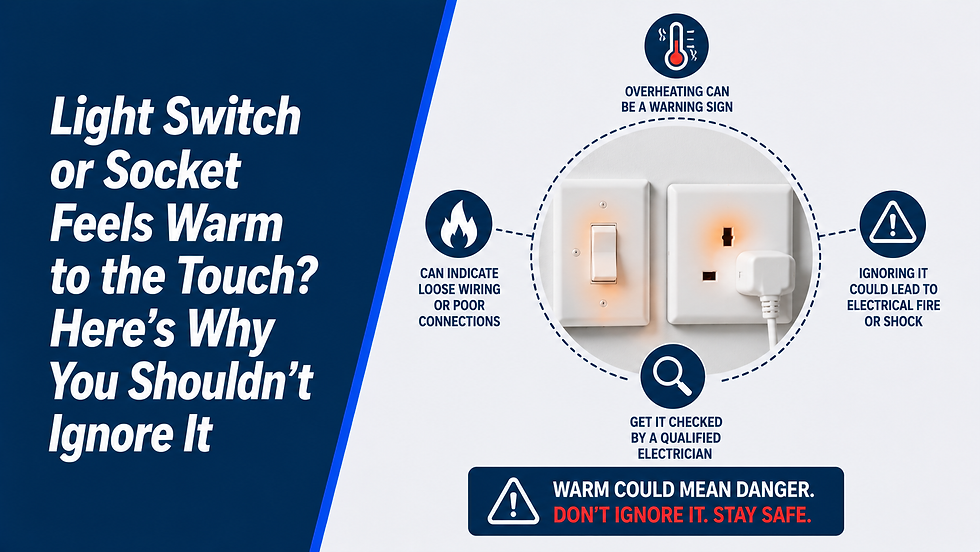
TL;DR
If a light switch or socket feels warm to the touch, it is almost always a loose connection or an overloaded circuit generating resistive heat, and it is a recognised precursor to electrical fires.
A small amount of warmth on a heavily loaded socket (like one running a kettle or heater) can be normal. Warmth on a light switch, an empty socket, or one running a low-power device is not.
A routine visual inspection, and even a standard EICR, can miss this fault because both rely on what is visible or measurable at the time of the test, not on heat building up under load over hours or days.
A thermal imaging survey is the only practical way to see this kind of fault developing before it causes an outage, a burn mark, or a fire.
If you find a warm switch or socket, stop using it, do not attempt a DIY fix, and get a qualified electrician or a thermal imaging survey booked as soon as possible, especially in healthcare and other high-occupancy buildings.
A Warm Switch or Socket Is Rarely Nothing
If you have just pressed a light switch or touched a socket faceplate and felt real warmth, not just body-temperature plastic, the direct answer is this: it is almost always a loose connection or an overloaded circuit building up resistive heat, and it is a recognised precursor to electrical fires. It is not a fault you should wait out or monitor for a few weeks. It is a signal that something inside the wall, behind that faceplate, is not making the clean, low-resistance contact it is supposed to make.
This matters more than most facilities teams realise, because a warm switch or socket rarely announces itself with a trip, a bang, or an obvious spark. It just sits there, quietly getting hotter every time the circuit is used, until one day it either stops working, discolours the faceplate, or in the worst cases, ignites the surrounding insulation or plasterboard. Electrical faults of this kind are one of the most common causes of accidental fires in commercial and public buildings in the UK, and a warm switch or socket feels warm is frequently the only early warning a responsible person gets.
This guide explains what is actually happening behind the faceplate, why your last EICR may not have caught it, and what to do next, including why a thermal imaging survey is the tool built specifically for finding this kind of fault before it becomes a shutdown or a fire.
What Does It Mean When a Socket Feels Warm?
When a socket feels warm, it means current is meeting resistance somewhere it should not be, and that resistance is being converted into heat. Electricity should flow through a clean, tight connection with almost no resistance and almost no heat. The moment a connection loosens, corrodes, or is undersized for the load running through it, resistance rises sharply at that exact point, and heat follows.
Loose Connections and Resistive Heating
The single most common cause of a warm switch or socket is a loose terminal screw inside the back box. Screw terminals can work themselves slightly loose over years of thermal expansion and contraction, vibration from nearby equipment, or simply because they were never fully tightened during the original installation or a later alteration. A loose connection has a smaller effective contact area than a tight one, so the same current is squeezed through a narrower path. That narrow path heats up, and the heat itself can further loosen the connection, which increases resistance again. This is a self-reinforcing cycle, which is exactly why a warm switch left unaddressed tends to get worse, not better.
Overloaded Circuits
The second common cause is a circuit or an individual socket carrying more current than it, or the wiring feeding it, was designed for. This is especially common where extension leads, adaptors, or multi-way blocks have been daisy-chained onto a single socket outlet over time, often without anyone in the building being aware of the cumulative load. An overloaded circuit produces heat throughout the run, but it is often most noticeable at the socket faceplate itself, because that is the point people actually touch.
Failing Internal Components
Less commonly, the switch or socket mechanism itself can be the problem. Backstab or push-fit terminals (common in older domestic-grade fittings) are more prone to poor contact than proper screw terminals. Cheap or worn switch mechanisms can also develop increased contact resistance inside the switch itself as the contacts wear or pit over repeated use.
Is a Warm Light Switch Always Dangerous?
Not every warm accessory is a fire waiting to happen, but the pattern matters more than the temperature alone. A socket feeding a kettle, space heater, or other high-draw appliance can feel mildly warm during and immediately after use, and that alone is not necessarily abnormal. What is abnormal, and what should prompt immediate action, is warmth on a light switch (which carries very little current), warmth on a socket that is not in use or is only running a phone charger or a laptop, or any warmth accompanied by discolouration, a burning smell, buzzing, or a switch that feels loose or wobbly in the wall plate.
If you are ever unsure whether what you are feeling is normal or not, treat it as not normal. The cost of an unnecessary call-out is trivial compared with the cost of an electrical fire.
Why a Routine Visual Inspection or Even an EICR Can Miss This
This is the part most responsible persons and facilities managers do not expect: a periodic Electrical Installation Condition Report (EICR) is a snapshot, not a continuous monitor. It tests insulation resistance, earth continuity, and polarity at a single point in time, and a competent electrician will visually check accessible accessories for obvious damage. But an EICR does not, and cannot, measure how hot a connection gets under real, sustained load over the course of a working day. A loose connection can pass every dead test in the book and still run hot enough to be a genuine fire risk once live current is flowing through it for hours at a time.
A visual inspection has the same blind spot. Heat is often invisible to the naked eye until it has already caused visible damage, such as scorching, melted plastic, or a discoloured faceplate, at which point the fault has usually been developing for weeks or months. By the time you can see it, you have already been carrying the risk for a considerable period.
This is not a criticism of routine electrical testing. Fixed wire testing and EICRs remain essential and are a legal requirement for most commercial premises under the Electricity at Work Regulations 1989 and the Regulatory Reform (Fire Safety) Order 2005. They are simply answering a different question to the one a warm switch or socket is asking.
How a Thermal Imaging Survey Catches It Before Failure
A thermal imaging survey uses an infrared camera to capture the actual surface temperature of live electrical equipment, accessories, and connections while the building is operating normally, under its real working load. Instead of testing whether a circuit passes or fails against a fixed threshold, it shows a facilities manager or responsible person exactly where heat is concentrating right now, expressed as a visible temperature gradient across sockets, switches, distribution boards, and connections.
This is precisely why thermal imaging finds faults that a routine inspection or an EICR does not: it is measuring the condition that actually causes fires (heat under load) rather than a proxy for it. A loose connection that would pass a dead insulation test with no problem at all will often show up immediately on a thermal image as a hot spot several degrees above its surroundings, long before it is anywhere near hot enough to be visible, smell of burning, or trip a protective device.
For a single reported symptom, such as one warm switch or socket, a targeted thermal imaging check of that circuit and the wider distribution board it feeds from is usually the fastest way to confirm the cause and its severity, and to establish whether the same fault pattern exists elsewhere in the building that has not yet been noticed.
What Should You Do Next?
If you or a member of staff has noticed a warm light switch or socket, do not treat it as something to keep an eye on. Take these steps.
Stop Using the Circuit Where Practical
Where it is safe and practical to do so, stop using the specific socket or switch, and unplug any equipment connected to it, until it has been checked. Do not attempt to remove the faceplate or investigate the wiring yourself.
Do Not Attempt a DIY Fix
Tightening a terminal screw sounds simple, but working inside a live back box without isolating the circuit correctly and understanding what you are looking at is genuinely dangerous, and in a commercial building it is also very likely to breach your legal duties under the Electricity at Work Regulations 1989. This is a job for a qualified electrician, not a screwdriver and good intentions.
Book a Thermal Imaging Survey
A thermal imaging survey is the most direct way to confirm what is causing the heat, how hot the connection is actually running, and whether the same issue is present elsewhere on the same circuit or distribution board. Because it is non-invasive and does not require an isolation or shutdown to carry out, it can usually be scheduled quickly without disrupting the building.
Arrange Remedial Works Promptly
If the survey confirms a fault, get electrical remedial repairs arranged promptly rather than treating the finding as something to schedule around a future planned maintenance visit. A confirmed hot connection is an active risk, not a future one.
Why This Matters More in Healthcare and High-Risk Environments
In healthcare settings, care homes, and other high-occupancy or high-risk buildings, a warm switch or socket carries consequences well beyond the immediate fire risk. Many of these environments cannot simply evacuate a ward, an operating theatre, or a residential care wing at short notice, which makes prevention far more valuable than reaction. They also frequently run continuous electrical loads (medical equipment, refrigeration for medicines, monitoring systems) where an unplanned outage caused by a failed connection is not just inconvenient, it can be clinically significant.
For these buildings, a scheduled programme of thermal imaging surveys, rather than a one-off check after a symptom is reported, is generally the more appropriate approach. It allows faults to be found and corrected while they are still minor electrical issues, rather than after they have escalated into an emergency shutdown or worse. This sits alongside routine electrical compliance testing and RCD testing as part of a complete picture of electrical safety, rather than a replacement for it.
If you want to understand more about how this kind of survey works at the distribution board level, where the same heat-under-load principle applies to busbars and breaker connections rather than a single socket, our guide to thermal imaging distribution board surveys covers what the survey can and cannot tell you in more detail. The same underlying fault, a connection running hotter than it should under normal load, is also what sits behind burning smells from switchgear, just at a larger scale and further up the distribution system.
Frequently Asked Questions
Is a warm light switch always a sign of a problem?
Generally, yes. Light switches carry very little current compared with power sockets, so there is little legitimate reason for one to feel warm during normal use. Warmth on a light switch usually points to a loose connection or a failing switch mechanism and should be checked promptly rather than monitored.
Can a warm socket cause a fire?
Yes. A warm socket is a sign of resistive heating at a connection point, and if left unaddressed this heat can increase over time, eventually reaching a level that ignites surrounding insulation, dust, or plasterboard. This is one of the recognised causes of electrical fires in both domestic and commercial buildings.
Why does my socket feel warm even when nothing is plugged in?
If a socket feels warm with nothing plugged into it, the heat is most likely coming from a loose or failing connection further back in the wiring, such as at the terminal inside the back box, or from a shared neutral or upstream connection carrying load from other parts of the circuit. It is not a fault you can diagnose from the faceplate alone, and it warrants an electrician's inspection.
Will an EICR pick up a warm switch or socket?
Not reliably. An EICR tests the electrical installation's condition using dead tests such as insulation resistance and earth continuity, carried out at a single point in time. It does not measure how hot a connection runs under real, sustained load, which is exactly the condition that causes a switch or socket to feel warm. A thermal imaging survey, carried out while the building is operating normally, is far better suited to catching this specific issue.
What is causing the heat if the circuit isn't overloaded?
If the circuit is not overloaded, the most likely cause is a loose or corroded terminal connection, a worn switch or socket mechanism, or a poor-quality backstab connection inside the accessory itself. Any of these creates a point of higher resistance than the rest of the circuit, and that single point heats up disproportionately even though the overall load is entirely normal.
How urgently should I get a warm switch or socket checked?
Treat it as urgent rather than routine. Stop using the affected switch or socket where practical, avoid investigating it yourself, and arrange for a qualified electrician or a thermal imaging survey within days, not weeks. The risk with this type of fault is that it tends to worsen gradually and without further obvious warning until it fails.
How does a thermal imaging survey find this kind of fault?
A thermal imaging survey uses an infrared camera to capture the actual surface temperature of switches, sockets, and connections while the building is under its normal working load. A loose or high-resistance connection shows up as a distinct hot spot, often several degrees warmer than the surrounding area, well before it is hot enough to be felt by hand, smell of burning, or cause a visible mark. This makes it one of the most effective non-invasive ways to confirm and locate the exact cause of a warm switch or socket.


.png)