
Fire Alarm Call Point Cover Missing or Broken? Here's Why It's More Than a Minor Repair
TL;DR
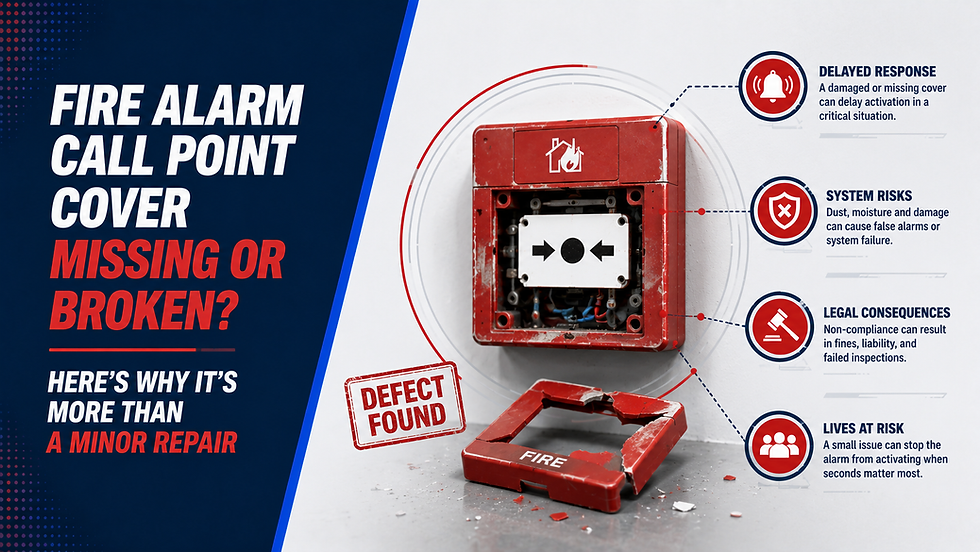
A missing, cracked or hanging call point cover is a genuine fire risk assessment finding, not a routine facilities repair to leave on a list.
It compromises how the manual call point operates and can affect how quickly and reliably an alarm activation is registered.
In healthcare and other high-risk sector buildings, this defect needs treating as urgent, not filed away for the next planned maintenance visit.
Replacement covers are inexpensive and fast to fit, but the inspection, sign-off and record-keeping around the repair matter just as much as the part itself.
Routine fire alarm servicing and a properly maintained fire risk assessment are what catch this defect early and close it out before it becomes an enforcement issue.
If a member of staff has just spotted a manual call point with a cracked, hanging or missing call point cover on a ward, corridor or stairwell wall, the direct answer is yes, this counts as a fire safety finding and should be logged and actioned today, not left for the next routine walk-round. A call point cover protects the break-glass element and the electrical contacts underneath from knocks, moisture and accidental activation, so once it's damaged or gone, the point itself is more vulnerable to false triggers, corrosion and, in the worst case, failing to register a genuine alarm when someone needs it to.
Is a Broken Call Point Cover Really a Fire Risk?
Yes, a broken or missing call point cover is treated as a fire risk assessment finding because it affects the reliability of a life safety device, not just its appearance. Fire risk assessors and fire alarm engineers class manual call points as part of the detection and alarm system, so any damage that could stop the point working as designed, whether that's exposed wiring, a hanging cover catching on clothing, or moisture getting into the contacts, gets recorded and risk-rated in the same way as a fault on a smoke detector or sounder.
Why Does the Cover Matter So Much on a Manual Call Point?
The cover matters because it's the only thing standing between the break-glass mechanism and the everyday knocks, spills and traffic of a busy building. Underneath sits a fragile glass or plastic element and a set of electrical contacts wired back to the fire alarm panel. Without its cover, that element is exposed to accidental damage, dust ingress and tampering, all of which increase the chance of a false alarm or, more seriously, a genuine activation not being detected and passed through to the panel correctly.
What Actually Sits Behind the Cover
Behind most call point covers is a resettable or frangible element, a small circuit board, and the wiring loop that connects the point to the rest of the fire alarm circuit. Any of these can be affected once the cover is gone, which is why engineers treat a missing cover as a functional issue rather than a cosmetic one.
What Should You Do When You Find One?
The right response is to report it immediately to whoever manages fire safety on site, and to make sure it's logged as a fire safety defect rather than a general maintenance ticket. In the short term, the call point should be checked to confirm it still operates correctly, the area around it kept clear, and a temporary marker or notice used if the point looks like it could be mistaken for out of use.
Immediate Steps for Facilities and Estates Teams
Facilities teams should isolate the specific point with the alarm panel if instructed by a competent engineer, record the defect with a photo, date and location, and raise a same-day or next-day works order depending on the building's risk profile. Waiting for a scheduled planned maintenance visit is not appropriate once the defect has been identified.
Interim Measures Before Replacement
Where a replacement cover cannot be fitted immediately, an engineer should confirm the point is still capable of triggering the alarm circuit and note this on the fire alarm log book. This interim check gives a documented basis for saying the building remains protected while the physical repair is arranged.
How Does This Get Picked Up and Closed Out?
This type of defect is normally caught during routine fire alarm servicing, alongside checks like emergency light testing, or during a scheduled fire risk assessment, both of which include a visual and functional check of every call point on site. Once identified, it should be logged with a clear remedial timescale, assigned to a contractor, and closed out with evidence, whether that's a photo of the replaced cover or an updated entry in the fire safety log book, so the finding doesn't simply disappear from view. If you need this looked at professionally, you can book a fire alarm and fire safety inspection rather than waiting for the next scheduled visit.
Why High-Risk Sector Sites Can't Treat This as Low Priority
In healthcare and other high-risk sector environments, evacuation is often assisted rather than immediate, which means the alarm and detection system has to work exactly as intended every time. A damaged call point cover in a ward, treatment room or corridor is exactly the kind of "small" defect that gets logged and left, yet it directly affects whether staff can raise the alarm quickly and reliably during an incident. Sites like hospitals and care settings, such as the work delivered at Northampton General Hospital, should treat any call point cover issue as a same-day priority, supported by a fire risk assessment programme that actively looks for this kind of finding rather than waiting for it to be reported.
Frequently Asked Questions
Is a broken call point cover a fire risk assessment finding?
Yes. A cracked, missing or hanging call point cover is recorded as a finding on a fire risk assessment because it affects the reliability of a life safety device. Assessors and engineers treat it the same way as a fault on a detector or sounder, not as a cosmetic issue.
Can I still use a manual call point if the cover is cracked?
The call point may still function, but it should not be left in that condition. A cracked call point cover exposes the break-glass element and electrical contacts to damage and moisture, so it needs checking by a competent engineer and replacing as soon as possible.
How quickly should a missing call point cover be replaced?
It should be treated as a same-day or next-day repair rather than added to a routine maintenance list, particularly in healthcare and other high-risk sector buildings. The urgency depends on the building's risk profile, but the finding itself should never wait for a scheduled visit.
Why do call point covers get damaged so often?
Call point covers are usually mounted at hand height in corridors, stairwells and wards, which makes them vulnerable to knocks from trolleys, furniture and passing traffic. Over time this everyday contact cracks the plastic or loosens the fixing until the cover falls away completely.
Does a broken call point cover affect fire alarm testing results?
It can. A weekly fire alarm test checks that the system responds correctly, but a damaged cover can affect how reliably the point operates under everyday conditions, which is why engineers note cover damage separately during routine servicing rather than waiting for a test to fail.
Who is responsible for fixing a broken call point cover in a shared building?
Responsibility usually sits with whoever holds the Responsible Person duty for fire safety under the Regulatory Reform (Fire Safety) Order, which in a shared or multi-let building is often the managing agent or landlord unless a lease states otherwise. It should be reported through the same channel as any other fire safety defect.
What's the difference between a call point cover and a call point break glass?
The cover is the outer casing that protects the device from knocks and moisture, while the break glass is the frangible element inside that the user presses or breaks to trigger the alarm. A missing cover exposes the break glass and its contacts, which is why the two are assessed together rather than separately.



.png)